7 Strategies for Conflict Resolution in the Workplace
Master 7 effective strategies for conflict resolution to foster a harmonious and productive workplace.
7 Strategies for Conflict Resolution in the Workplace
Master 7 effective strategies for conflict resolution to foster a harmonious and productive workplace. Conflict is an inevitable part of any human interaction, and the workplace is no exception. Whether it's a disagreement over project priorities, a clash of personalities, or differing opinions on how to achieve a goal, conflicts can arise from various sources. While often viewed negatively, conflict, when managed effectively, can actually be a catalyst for innovation, improved communication, and stronger team bonds. The key lies in understanding how to approach and resolve these disagreements constructively. This article will delve into seven powerful strategies for conflict resolution in the workplace, offering practical advice and tools to help you navigate these challenging situations with grace and effectiveness. We'll also explore how specific digital tools can aid in these processes, providing concrete examples and comparisons.
Understanding Workplace Conflict Types and Causes
Before diving into resolution strategies, it's crucial to understand the different types of workplace conflicts and their common causes. Conflicts can range from minor disagreements to deep-seated interpersonal issues. Recognizing the root cause is the first step towards an effective resolution.
Common Conflict Triggers in Professional Settings
- Communication Breakdowns: Misunderstandings, lack of clarity, or poor listening skills often lead to conflict.
- Differing Personalities and Work Styles: Individuals have unique ways of approaching tasks and interacting, which can sometimes clash.
- Competition for Resources: Limited budgets, staff, or time can create tension and competition among teams or individuals.
- Unclear Roles and Responsibilities: Ambiguity about who is responsible for what can lead to duplication of effort or neglected tasks, causing friction.
- Conflicting Goals and Priorities: When different departments or individuals have competing objectives, conflict is almost guaranteed.
- Ethical Disagreements: Differences in moral or ethical stances can lead to significant workplace disputes.
- Power Imbalances: Perceived or actual power imbalances can create resentment and conflict.
Strategy 1 Active Listening and Empathy for Better Understanding
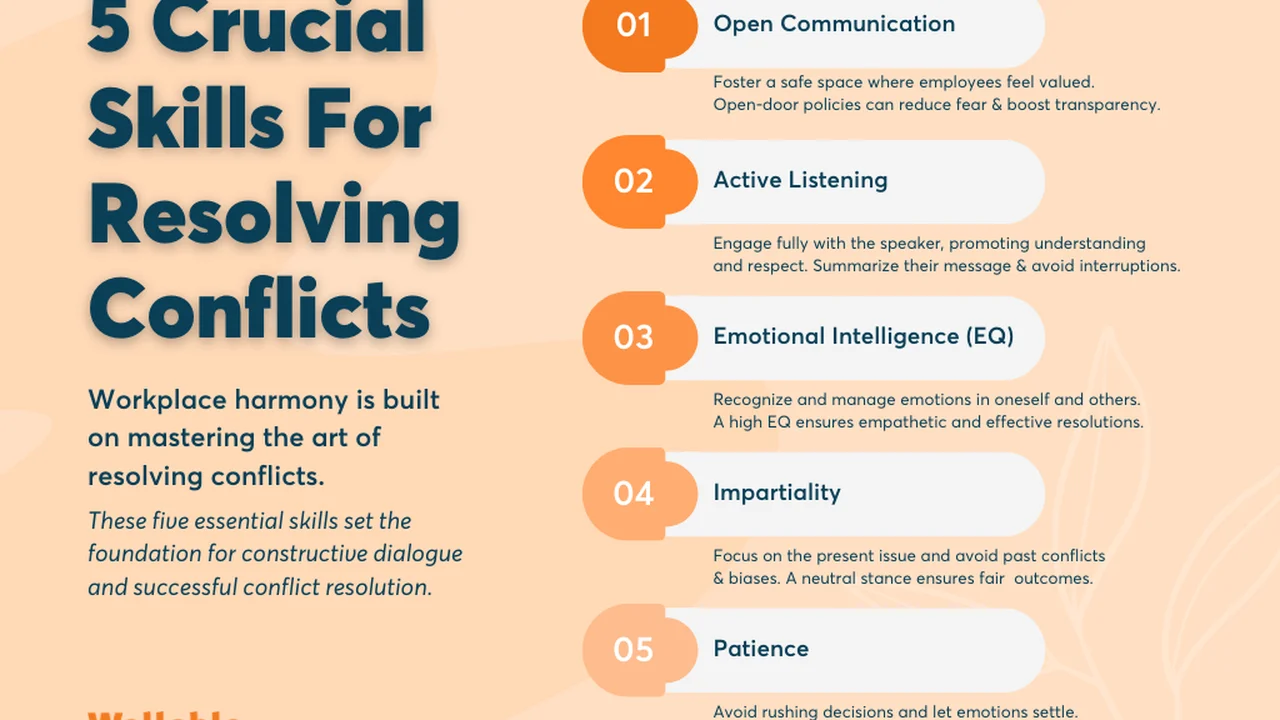
One of the most fundamental and powerful conflict resolution strategies is active listening combined with empathy. This isn't just about hearing words; it's about truly understanding the other person's perspective, feelings, and underlying needs. When people feel heard and understood, they are more likely to engage in a constructive dialogue.
Techniques for Active Listening and Empathetic Responses
- Pay Full Attention: Put away distractions, make eye contact, and focus solely on the speaker.
- Reflect and Paraphrase: Repeat back what you've heard in your own words to confirm understanding. For example, 'So, if I understand correctly, you're feeling frustrated because...'
- Ask Open-Ended Questions: Encourage the other person to elaborate on their thoughts and feelings. Questions like 'Can you tell me more about that?' or 'How did that make you feel?' are effective.
- Validate Feelings: Acknowledge their emotions without necessarily agreeing with their viewpoint. Statements like 'I can see why you'd feel that way' can de-escalate tension.
- Avoid Interrupting: Let the other person finish their thoughts completely before you respond.
Strategy 2 Focus on Interests Not Positions for Collaborative Solutions
Often, in a conflict, people state their 'positions' – what they want. However, behind every position are deeper 'interests' – why they want it. Shifting the focus from rigid positions to underlying interests can unlock creative, mutually beneficial solutions. This strategy is a cornerstone of principled negotiation.
Identifying Underlying Interests and Shared Goals
Instead of arguing over who gets to lead a project (a position), explore why each person wants to lead (their interests). One might want to gain leadership experience, while another might want to ensure the project aligns with their department's strategic goals. Once interests are identified, it's often possible to find solutions that satisfy both parties' core needs, even if their initial positions seemed incompatible.
Strategy 3 Choose the Right Time and Place for Productive Discussions
The environment in which a conflict is addressed significantly impacts its outcome. Rushing into a discussion when emotions are high or in a public setting can exacerbate the problem. Choosing a neutral, private, and appropriate time is crucial for a productive conversation.
Setting the Stage for Effective Conflict Resolution Meetings
- Private Setting: Ensure confidentiality and minimize distractions.
- Neutral Ground: If possible, meet in a neutral space rather than one person's office.
- Appropriate Timing: Avoid discussing sensitive issues when either party is stressed, rushed, or nearing the end of their workday. Schedule a dedicated time.
- Prepare Mentally: Both parties should ideally come to the discussion with a calm mindset and a willingness to resolve the issue.
Strategy 4 Use 'I' Statements to Express Feelings and Needs Clearly
When discussing a conflict, it's easy to fall into the trap of using 'you' statements, which can sound accusatory and put the other person on the defensive. 'I' statements, on the other hand, focus on your own feelings and needs, making the conversation less confrontational and more constructive.
Crafting Effective 'I' Statements for Non-Confrontational Communication
An 'I' statement typically follows this structure: 'I feel [emotion] when [specific behavior] because [impact on you].'
- Instead of: 'You always interrupt me in meetings!' (Accusatory 'you' statement)
- Try: 'I feel unheard and frustrated when I'm interrupted during meetings because it makes it difficult for me to convey my ideas fully.' (Effective 'I' statement)
This approach encourages the other person to listen and understand your perspective without feeling attacked.
Strategy 5 Brainstorm Solutions Together for Mutual Benefit
Once the underlying interests are understood and feelings have been expressed, the next step is to collaboratively brainstorm potential solutions. This moves the conversation from problem-focused to solution-focused, encouraging creativity and shared ownership of the outcome.
Collaborative Problem Solving Techniques and Tools
- Generate Multiple Options: Don't settle for the first idea. Encourage both parties to come up with several possible solutions.
- No Judgment During Brainstorming: Allow all ideas, no matter how unconventional, to be put on the table without immediate criticism.
- Focus on Mutual Gain: Look for solutions that address the core interests of both parties, rather than a win-lose scenario.
- Consider Consequences: Discuss the potential pros and cons of each proposed solution.
Digital Tools for Collaborative Brainstorming and Decision Making
In today's hybrid and remote work environments, digital tools can significantly enhance collaborative brainstorming and decision-making processes during conflict resolution. Here are a few recommendations:
Miro
- Description: Miro is an online collaborative whiteboard platform designed for team collaboration. It offers a vast canvas where users can brainstorm, map ideas, create flowcharts, and more.
- Use Case: Ideal for remote teams to visually map out conflict points, identify underlying interests, and brainstorm solutions together in real-time. You can use sticky notes for ideas, connect them with arrows to show relationships, and even use pre-built templates for conflict resolution frameworks.
- Comparison: More versatile than simple document sharing, offering a dynamic visual space. It's more structured than a basic video call for brainstorming.
- Pricing: Free plan available for small teams with limited boards. Paid plans start around $10 per user per month for more features and unlimited boards.
Google Docs / Microsoft Word Online
- Description: These are cloud-based word processors that allow multiple users to edit a document simultaneously, track changes, and leave comments.
- Use Case: Useful for documenting the conflict, outlining agreed-upon interests, and drafting potential solutions in a structured text format. The comment feature can be used for asynchronous feedback.
- Comparison: Simpler and more text-focused than Miro. Good for formalizing agreements.
- Pricing: Free with a Google account; Microsoft 365 subscriptions start around $6 per user per month for business plans.
Slack / Microsoft Teams
- Description: Communication platforms that offer instant messaging, channels for specific topics, and integration with other tools.
- Use Case: While not for the core resolution meeting, these platforms can be used for initial communication to schedule a meeting, share relevant documents beforehand, or follow up on agreed-upon actions. Private channels can be created for sensitive discussions.
- Comparison: Primarily communication tools, less about structured brainstorming. Good for quick check-ins and logistical arrangements.
- Pricing: Free basic plans available. Paid plans for more features and integrations start around $7 per user per month for Slack and $4 per user per month for Microsoft Teams.
Strategy 6 Agree on a Plan and Follow Up for Lasting Resolution
A conflict isn't truly resolved until a clear plan of action is agreed upon and implemented. This involves outlining specific steps, assigning responsibilities, and setting timelines. Crucially, there must be a follow-up mechanism to ensure the plan is working and to make adjustments if necessary.
Creating Actionable Plans and Ensuring Accountability
- Specific Actions: Clearly define what each person will do.
- Responsibilities: Assign who is responsible for each action.
- Timelines: Set realistic deadlines for completing tasks.
- Monitoring and Review: Schedule a follow-up meeting to check on progress and address any new issues that may arise.
- Documentation: Document the agreed-upon plan to avoid future misunderstandings.
Strategy 7 Know When to Involve a Third Party for Impartial Mediation
Sometimes, despite best efforts, two parties cannot resolve a conflict on their own. In such cases, involving a neutral third party – a manager, HR representative, or an external mediator – can be essential. A mediator doesn't take sides but facilitates communication and guides the parties towards a resolution.
The Role of Mediators and When to Seek External Help
- Impartiality: A good mediator remains neutral and focuses on the process, not the outcome.
- Facilitation: They help both parties articulate their views, listen to each other, and explore solutions.
- Confidentiality: Mediation sessions are typically confidential, creating a safe space for open discussion.
- When to Involve: Consider mediation when communication has broken down, emotions are too high, power imbalances exist, or previous attempts at resolution have failed.
Tools for Facilitating Third-Party Mediation
While human mediators are irreplaceable, certain tools can support the mediation process, especially in remote settings.
Zoom / Google Meet
- Description: Video conferencing platforms essential for remote mediation sessions.
- Use Case: Facilitating virtual meetings with a mediator and conflicting parties. Features like breakout rooms can be used for private conversations with each party.
- Comparison: Standard for virtual meetings, offering reliable video and audio.
- Pricing: Free basic plans with time limits. Paid plans for extended meetings and more features start around $15 per host per month.
SurveyMonkey / Google Forms
- Description: Tools for creating online surveys and forms.
- Use Case: A mediator might use these to gather anonymous feedback from both parties before a session to understand perspectives without direct confrontation, or to gauge satisfaction with a resolution plan.
- Comparison: Simple and effective for collecting structured data or feedback.
- Pricing: Free basic plans. Paid plans for advanced features start around $30 per month.
Effectively managing conflict is a critical skill for anyone in the workplace, from individual contributors to senior leaders. By applying these seven strategies – active listening, focusing on interests, choosing the right environment, using 'I' statements, collaborative brainstorming, agreeing on a plan, and knowing when to involve a third party – you can transform potentially destructive disagreements into opportunities for growth and stronger relationships. Remember, conflict isn't about winning or losing; it's about finding a path forward that works for everyone involved, fostering a more harmonious and productive work environment for all.
:max_bytes(150000):strip_icc()/277019-baked-pork-chops-with-cream-of-mushroom-soup-DDMFS-beauty-4x3-BG-7505-5762b731cf30447d9cbbbbbf387beafa.jpg)