4 Differences Between Empathy and Sympathy Explained
Understand the 4 crucial differences between empathy and sympathy. Enhance your interpersonal connections and understanding.
Understand the 4 crucial differences between empathy and sympathy. Enhance your interpersonal connections and understanding.
4 Differences Between Empathy and Sympathy Explained
Understanding the Core Concepts Empathy vs Sympathy
Hey there! Ever found yourself in a conversation where someone’s going through a tough time, and you’re trying to figure out the best way to respond? You might hear terms like 'empathy' and 'sympathy' thrown around, often interchangeably. But here’s the thing: they’re not the same. While both involve responding to someone else's feelings, they do so in fundamentally different ways. Grasping these differences isn't just academic; it can genuinely transform how you connect with people, whether it's a friend, a family member, or even a colleague. Let's dive deep into what sets these two powerful human responses apart.
Think of it this way: imagine your friend just lost their job. You want to be supportive, right? But how you approach that support – whether you offer sympathy or empathy – will dictate the quality of your interaction and how your friend feels understood. One might offer a comforting pat on the back and a 'I'm so sorry that happened to you,' while the other might say, 'I can only imagine how overwhelming this must feel right now, I remember feeling something similar when I went through a tough career change.' See the subtle but significant shift? That's what we're going to unpack.
Difference 1 Perspective Taking vs Feeling Sorry Empathy's Deep Dive
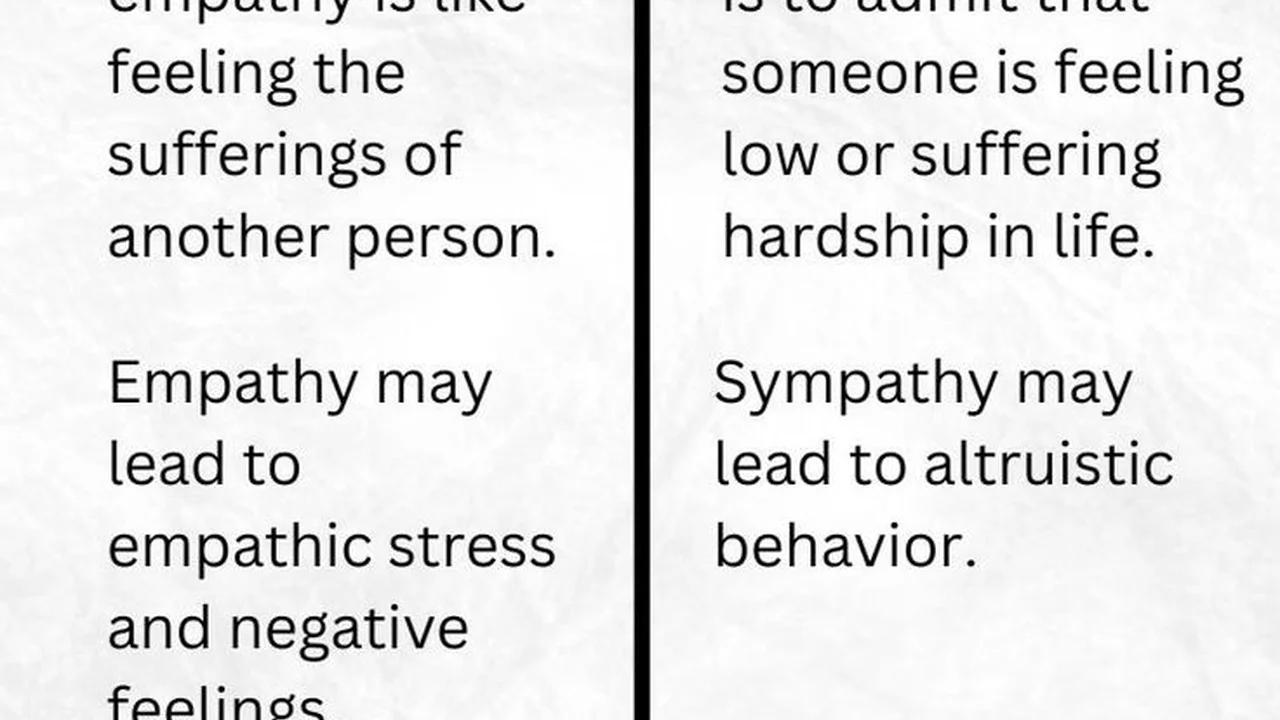
The first and perhaps most significant difference lies in the perspective you take. Empathy is all about perspective-taking. It's the ability to understand and share the feelings of another. When you're empathetic, you're essentially putting yourself in someone else's shoes, trying to see the world from their vantage point, and feeling with them. It's an active, imaginative process where you attempt to grasp their emotional state as if it were your own, without necessarily experiencing the exact same event.
Consider this: if your friend is heartbroken over a breakup, an empathetic response isn't just saying 'That's awful.' It's trying to recall a time you felt similar heartbreak, or at least imagining the profound pain of losing someone you loved. You might say, 'I remember how crushing it felt when my first serious relationship ended. The world just seemed to stop. Is that anything like what you're feeling?' This isn't about making it about you; it's about using your own emotional library to connect with their experience. It requires a certain level of emotional intelligence and self-awareness to access those feelings and then project them onto another's situation.
On the other hand, sympathy is more about feeling sorry for someone. It's an acknowledgment of their suffering and a desire to alleviate it, but without necessarily sharing their emotional experience. You recognize their pain from a distance. It's a feeling of pity or compassion. When you offer sympathy, you're standing on the sidelines, observing their struggle, and expressing concern. It's a valuable human response, don't get me wrong, but it doesn't involve the same level of emotional immersion.
Using the same breakup example, a sympathetic response might be, 'Oh, I'm so sorry to hear that. That's really tough.' You're acknowledging their pain, and you genuinely feel bad for them, but you're not necessarily trying to step into their emotional world. You're offering comfort from your own, separate emotional space. Both are valid, but one creates a deeper bridge.
Difference 2 Emotional Distance vs Emotional Connection Building Bridges
This leads us directly to the second key difference: emotional distance. With sympathy, there's an inherent emotional distance. You maintain your own emotional state while acknowledging theirs. It's like looking at someone struggling in a deep pit from the edge. You can see their struggle, you can feel bad for them, and you might even throw down a rope, but you're not in the pit with them.
This distance can sometimes be perceived as condescending, even if unintentionally. When you say 'I'm so sorry for your loss,' it's a kind and appropriate response, but it doesn't necessarily convey a deep understanding of their specific grief. It's a general expression of sorrow. For some, this can feel isolating, as if their unique pain isn't fully recognized.
Empathy, however, actively seeks to close that emotional distance. It's about stepping into the pit with them, even if just for a moment. You're not necessarily experiencing their exact pain, but you're allowing yourself to be affected by it, to feel a resonance within your own emotional landscape. This creates a powerful emotional connection. When you're empathetic, you're saying, 'I'm here with you in this difficult space.' This shared emotional space can be incredibly validating and comforting for the person experiencing distress.
Think about a child who falls and scrapes their knee. A sympathetic parent might say, 'Oh, poor baby, that looks like it hurts!' An empathetic parent might get down to their level, look at the scrape, and say, 'Ouch, that looks really sore! I remember when I scraped my knee like that, it really stung.' The latter response acknowledges the child's pain and validates their experience by connecting it to a shared human experience of pain, even if the specific event is different.
Difference 3 Action Orientation vs Understanding Empathy's Power
The third difference often manifests in the kind of action or response that follows. Sympathy often leads to a desire to fix the problem or offer solutions. Because you're observing from a distance, your natural inclination might be to try and alleviate the discomfort. If your friend is struggling with a difficult boss, a sympathetic response might be, 'You should really talk to HR' or 'Maybe you should look for a new job.' These are well-intentioned suggestions, but they can sometimes feel dismissive of the person's current emotional state.
While offering solutions can be helpful at times, it can also inadvertently communicate that you don't fully understand the depth of their struggle or that you believe their feelings are something to be 'fixed' rather than acknowledged. Sometimes, people just need to be heard and understood, not immediately given a roadmap out of their pain.
Empathy, on the other hand, is less about immediate action or problem-solving and more about understanding and validation. An empathetic response prioritizes listening and acknowledging the other person's feelings. If your friend is struggling with their boss, an empathetic response might be, 'That sounds incredibly frustrating and draining. It must be really tough to go into work every day feeling like that.' This response doesn't offer a solution; it offers understanding and validates their experience. It communicates, 'I hear you, and I get it.'
This doesn't mean empathetic people never offer solutions. It means they prioritize understanding first. Once the person feels truly heard and understood, they might then be more receptive to suggestions or even come up with their own solutions. The power of empathy lies in creating a safe space for emotional expression, which is often the first step towards healing or finding a way forward.
Difference 4 Self Preservation vs Vulnerability The Emotional Cost
Finally, let's talk about the emotional cost and the level of vulnerability involved. Sympathy is generally a safer emotional space for the giver. You can offer sympathy without truly exposing your own emotions or vulnerabilities. It's a compassionate response that keeps your emotional boundaries intact. You can feel bad for someone without letting their pain deeply affect your own emotional state. This can be a form of self-preservation, which isn't inherently bad, especially in situations where you need to maintain professional distance or protect your own mental health.
For example, a doctor might feel sympathy for a patient's suffering, but they need to maintain a certain emotional distance to make objective medical decisions. Too much empathy in such a situation could lead to burnout or impaired judgment. So, sympathy has its place and its utility.
Empathy, however, requires a degree of vulnerability. To truly step into someone else's emotional world, you have to open yourself up to the possibility of feeling some of their pain or discomfort. It requires you to tap into your own emotional experiences and allow them to resonate with another's. This can be emotionally taxing and requires a certain level of emotional resilience. It's a risk, in a way, because you're allowing yourself to be affected.
Brené Brown, a renowned researcher on vulnerability, often talks about empathy as 'feeling with people.' She illustrates it beautifully by saying, 'Rarely can a response make something better. What makes something better is connection.' And connection often requires vulnerability. When you're empathetic, you're saying, 'I'm willing to feel uncomfortable with you.' This act of shared vulnerability is what often forges the deepest bonds and makes people feel truly seen and supported.
Practical Applications Enhancing Your Connections
So, how can you apply this understanding in your daily life? It's not about choosing one over the other in every situation, but rather understanding when each is most appropriate and how to cultivate both. Here are some practical tips and even some tools that can help you enhance your empathetic and sympathetic responses.
Tools for Cultivating Empathy and Active Listening Skills
To truly practice empathy, active listening is paramount. You need to hear not just the words, but the emotions behind them. Here are some resources and tools that can help:
- Books on Emotional Intelligence: Reading books like Daniel Goleman's Emotional Intelligence or Brené Brown's Daring Greatly can provide a solid theoretical foundation and practical exercises.
- Mindfulness Apps: Apps like Calm (iOS/Android, Subscription: ~$70/year) or Headspace (iOS/Android, Subscription: ~$70/year) can help you develop greater self-awareness and emotional regulation, which are crucial for empathetic responses. By understanding your own emotions better, you can more effectively understand others'.
- Journaling: Regularly journaling about your own feelings and experiences can increase your emotional vocabulary and help you connect with a wider range of human emotions.
- Online Courses on Communication: Platforms like Coursera or edX offer courses on 'Nonviolent Communication' or 'Active Listening' that can provide structured learning.
Products for Enhancing Communication and Understanding
While empathy is an internal skill, certain products can facilitate better communication and understanding, especially in professional or group settings:
- Communication Training Software: For teams, software like Loom (Free basic, Pro: $10/month) allows for video messaging that captures tone and facial expressions, which can convey more empathy than plain text. For more advanced training, platforms like BetterUp (Enterprise pricing) offer coaching that includes modules on empathetic leadership.
- Mood Tracking Apps: Apps like Daylio (iOS/Android, Free basic, Premium: $3/month) or Moodpath (iOS/Android, Free basic, Premium: $60/year) can help individuals track their own emotional patterns. Understanding your own emotional fluctuations can make you more attuned to others'.
- Empathy Cards/Games: Believe it or not, there are physical tools! Products like The Empathy Deck (Approx. $25 on Amazon) or The School of Life's Empathy Game (Approx. $30) are designed to spark conversations and encourage perspective-taking in a fun, interactive way. These are great for workshops or even family discussions.
- Noise-Cancelling Headphones: This might seem counterintuitive, but in a noisy environment, high-quality noise-cancelling headphones like Sony WH-1000XM5 (Approx. $350) or Bose QuietComfort Ultra Headphones (Approx. $430) can help you create a quiet space for focused listening during a call or video chat, allowing you to better concentrate on the speaker's tone and words without distraction. This is crucial for truly hearing and understanding.
Scenarios for Applying Empathy vs Sympathy
Let's look at a few scenarios to solidify your understanding:
Scenario 1: A colleague misses a big deadline.
- Sympathetic Response: 'Oh no, that's terrible. I hope you can fix it.' (Focuses on the outcome, expresses pity.)
- Empathetic Response: 'I can see how stressed you are right now. Missing a deadline like that must feel incredibly overwhelming, especially with all the pressure we've been under. What's going on?' (Acknowledges their emotional state, seeks to understand the underlying reasons, offers a space for them to share.)
Scenario 2: A friend is celebrating a major success.
- Sympathetic Response: 'That's great! Good for you!' (Acknowledges their success, but from a distance.)
- Empathetic Response: 'Wow, I remember how hard you worked for this, all those late nights and sacrifices. It must feel absolutely incredible to finally achieve it! I'm so genuinely happy for you!' (Connects to their journey, shares in their joy by recalling their effort, feels with them.)
Scenario 3: A family member is struggling with a chronic illness.
- Sympathetic Response: 'I'm so sorry you're going through this. I wish there was something I could do.' (Expresses pity and a desire to help, but maintains distance from the experience.)
- Empathetic Response: 'This must be incredibly challenging and exhausting for you, dealing with this every day. I can only imagine the frustration and pain you must feel. How are you really coping?' (Acknowledges the ongoing struggle, attempts to understand the emotional toll, invites deeper sharing.)
By consciously choosing to respond with empathy when appropriate, you can foster deeper, more meaningful connections in all areas of your life. It's a skill that takes practice, but the rewards in terms of stronger relationships and a more compassionate world are immeasurable. Keep practicing, keep listening, and keep trying to step into those shoes!
:max_bytes(150000):strip_icc()/277019-baked-pork-chops-with-cream-of-mushroom-soup-DDMFS-beauty-4x3-BG-7505-5762b731cf30447d9cbbbbbf387beafa.jpg)