Encrypted Messaging Apps A Comprehensive Guide
Explore the leading encrypted messaging applications for secure and private communication. This guide compares top apps like Signal, Telegram, WhatsApp, and Threema, detailing their features, security protocols, pricing, and ideal use cases for users in the US and Southeast Asia.
Explore the leading encrypted messaging applications for secure and private communication. This guide compares top apps like Signal, Telegram, WhatsApp, and Threema, detailing their features, security protocols, pricing, and ideal use cases for users in the US and Southeast Asia.
Encrypted Messaging Apps A Comprehensive Guide
In today's hyper-connected world, our digital conversations are more vulnerable than ever. From casual chats with friends to sensitive business discussions, the information we share through messaging apps can be intercepted, monitored, or even exploited. This is where encrypted messaging apps come in, offering a crucial layer of protection for your privacy. But with so many options available, how do you choose the right one? This comprehensive guide will dive deep into the world of encrypted messaging, comparing the leading applications, their security features, pricing, and ideal use cases, especially for users in the US and Southeast Asia.
Understanding End to End Encryption E2EE for Secure Messaging
At the heart of any secure messaging app is End-to-End Encryption (E2EE). But what exactly does that mean? Simply put, E2EE ensures that only the sender and the intended recipient can read the messages. No one in between, not even the messaging service provider, can access the content of your communication. This is achieved by encrypting the message on the sender's device and decrypting it only on the recipient's device. Think of it like a sealed envelope that only the person with the correct key can open. This fundamental technology is what makes encrypted messaging truly private and secure.
Different apps use different E2EE protocols. Some popular and well-regarded protocols include the Signal Protocol, which is widely considered the gold standard, and MTProto, used by Telegram. Understanding these protocols can help you gauge the level of security an app offers. For instance, the Signal Protocol is open-source and has been rigorously audited by security experts, giving it a strong reputation for trustworthiness. When evaluating an app, always look for clear statements about their E2EE implementation and whether it's enabled by default for all communications.
Key Features to Look for in a Secure Messaging App for US and SEA Users
Beyond E2EE, several other features contribute to an app's overall security and privacy posture. When choosing an encrypted messaging app, especially for diverse markets like the US and Southeast Asia, consider these factors:
- Default E2EE: Is E2EE enabled by default for all chats, or do you have to manually turn it on for 'secret chats'? Apps that offer E2EE by default provide a higher level of protection without requiring user intervention.
- Open Source Code: Apps with open-source code allow security researchers and the public to inspect their code for vulnerabilities. This transparency builds trust and helps identify potential weaknesses.
- Independent Security Audits: Has the app undergone independent security audits? These audits provide an unbiased assessment of the app's security practices and E2EE implementation.
- Data Collection Policies: What kind of metadata does the app collect? Some apps collect very little, while others might log IP addresses, contact lists, or usage patterns. A truly private app minimizes data collection.
- Self-Destructing Messages: This feature allows messages to automatically disappear after a set period, adding an extra layer of privacy, especially for sensitive conversations.
- Screenshot Prevention: Some apps offer features to prevent recipients from taking screenshots of messages, further enhancing confidentiality.
- Anonymity Features: Can you register and use the app without linking it directly to your phone number or other personal identifiers?
- Cross-Platform Availability: Does the app work seamlessly across different operating systems (iOS, Android, desktop) and devices?
- User Interface and Experience: While security is paramount, a user-friendly interface is crucial for widespread adoption and ease of use.
- Server Location and Jurisdiction: Where are the app's servers located, and what are the local data retention laws? This can be particularly relevant for users concerned about government surveillance.
Top Encrypted Messaging Apps A Detailed Comparison for Digital Privacy
Let's dive into a detailed comparison of some of the most popular and highly-regarded encrypted messaging apps, highlighting their strengths, weaknesses, and ideal use cases.
Signal The Gold Standard for Private Communication
Overview: Signal is widely regarded as the benchmark for secure and private messaging. It's developed by the Signal Foundation, a non-profit organization, and is powered by the open-source Signal Protocol, which is trusted by security experts worldwide. Edward Snowden himself has endorsed Signal for its robust privacy features.
Key Features:
- Default E2EE: All communications (messages, voice calls, video calls, group chats, file transfers) are end-to-end encrypted by default.
- Open Source: Both the client and server code are open source, allowing for public scrutiny.
- Minimal Metadata: Signal collects very little metadata, primarily only the time an account was created and the last time it connected to the service. It does not store your contact list, group information, or message content.
- Self-Destructing Messages: Users can set messages to disappear after a specified time.
- Screenshot Blocking: On Android, Signal can prevent screenshots within the app.
- Encrypted Backups: Offers optional encrypted backups to your local device.
- Note to Self: A private chat with yourself for secure notes.
- Proxy Support: Allows users to route traffic through a proxy to bypass censorship.
Pricing: Free to use.
Ideal Use Cases: Individuals and organizations prioritizing maximum privacy and security. Journalists, activists, and anyone handling highly sensitive information will find Signal to be an excellent choice. Its ease of use also makes it suitable for everyday communication for privacy-conscious users in the US and Southeast Asia.
Pros: Unparalleled security, strong privacy policy, open-source, minimal data collection, non-profit backing.
Cons: Requires a phone number for registration (though it can be a burner number), smaller user base compared to WhatsApp.
Telegram Feature Rich and Secure Messaging
Overview: Telegram is a popular messaging app known for its speed, cloud-based synchronization, and extensive features. While it offers E2EE, it's crucial to understand how it's implemented.
Key Features:
- Optional E2EE (Secret Chats): E2EE is only available in 'Secret Chats.' Regular cloud chats are encrypted client-to-server, but Telegram holds the decryption keys.
- Cloud-Based Chats: Messages in regular chats are stored on Telegram's servers, allowing for seamless synchronization across multiple devices.
- Large File Sharing: Supports sharing large files (up to 2 GB).
- Channels and Groups: Offers powerful features for large groups (up to 200,000 members) and broadcast channels.
- Self-Destructing Messages: Available in Secret Chats.
- Proxy Support: Built-in proxy support to bypass censorship.
- Bots: A rich ecosystem of bots for various functionalities.
Pricing: Free to use, with an optional Telegram Premium subscription offering additional features like faster downloads and exclusive stickers.
Ideal Use Cases: Users who value a feature-rich messaging experience, large group communication, and cloud synchronization, but are comfortable with E2EE being optional for most chats. It's very popular in some Southeast Asian countries for its group features and channels. For highly sensitive conversations, users must remember to initiate a 'Secret Chat.'
Pros: Fast, feature-rich, large groups/channels, cloud sync, free.
Cons: E2EE is not default for all chats, collects more metadata than Signal, MTProto protocol has faced some criticism from security researchers (though no known major vulnerabilities have been exploited).
WhatsApp The Ubiquitous Encrypted Messenger
Overview: Owned by Meta (Facebook), WhatsApp is the most widely used messaging app globally. It gained significant trust when it implemented E2EE for all communications, powered by the Signal Protocol.
Key Features:
- Default E2EE: All messages, calls, and media shared on WhatsApp are end-to-end encrypted by default, using the robust Signal Protocol.
- Large User Base: Its widespread adoption makes it easy to connect with almost anyone.
- Voice and Video Calls: High-quality voice and video calls.
- Group Chats: Supports group chats with up to 1024 participants.
- Disappearing Messages: Offers an option for messages to disappear after 24 hours, 7 days, or 90 days.
- Status Updates: Similar to Instagram Stories.
- Desktop App: Available for Windows and macOS.
Pricing: Free to use.
Ideal Use Cases: General communication for individuals and small groups who want the convenience of a large user base combined with default E2EE. It's a go-to app for many in the US and Southeast Asia due to its ubiquity. However, users concerned about Meta's data collection practices (even if message content is E2EE) might look for alternatives.
Pros: Widespread adoption, default E2EE (Signal Protocol), user-friendly, free.
Cons: Owned by Meta (privacy concerns regarding metadata collection and data sharing with Facebook), requires a phone number, backups to cloud services (Google Drive, iCloud) are not E2EE by default.
Threema Privacy Focused and Paid
Overview: Threema is a Swiss-based encrypted messaging app that emphasizes privacy and anonymity. Unlike many other apps, it's a paid service, which helps fund its operations without relying on advertising or data sales.
Key Features:
- Default E2EE: All communications are end-to-end encrypted.
- Anonymous Use: You can use Threema completely anonymously without linking it to a phone number or email address. It generates a unique Threema ID.
- Open Source: The client-side code is open source.
- Minimal Data Collection: Threema's servers are designed to store as little data as possible.
- Polls and Surveys: Built-in features for creating polls.
- File Sharing: Securely share various file types.
- Threema Work: A dedicated version for businesses with enhanced administrative features.
Pricing: One-time purchase (typically around $3.99 - $4.99 USD, varies by region and platform). Threema Work has subscription pricing.
Ideal Use Cases: Users who are willing to pay a small fee for enhanced anonymity and privacy, especially those who want to avoid linking their messaging app to a phone number. Excellent for individuals and businesses in the US and Southeast Asia where data privacy is a top concern and a small investment is acceptable.
Pros: High level of anonymity, strong privacy policy, open-source client, Swiss jurisdiction (strong privacy laws), no phone number required.
Cons: Paid app, smaller user base, less feature-rich than Telegram or WhatsApp in some areas.
Viber Secure Messaging with a Focus on Calls
Overview: Viber is another popular messaging and VoIP app, particularly strong in certain regions of Southeast Asia. It offers E2EE for one-on-one and group chats.
Key Features:
- Default E2EE: All one-on-one and group chats, as well as voice and video calls, are end-to-end encrypted.
- Hidden Chats: Allows users to hide specific chats from their main chat list, accessible only with a PIN.
- Self-Destructing Messages: Available in secret chats.
- Viber Out: Low-cost international calls to non-Viber users.
- Stickers and GIFs: A wide range of expressive content.
Pricing: Free to use, with in-app purchases for stickers and Viber Out credits.
Ideal Use Cases: Users who need a reliable messaging and calling app with E2EE, especially in regions where Viber has a strong presence. Its hidden chats feature adds an extra layer of discretion. Popular in some parts of Southeast Asia.
Pros: Default E2EE, hidden chats, good call quality, free.
Cons: Collects more metadata than Signal or Threema, not as transparent about its E2EE implementation as Signal, owned by a Japanese multinational company (Rakuten) which might raise some privacy concerns for highly sensitive users.
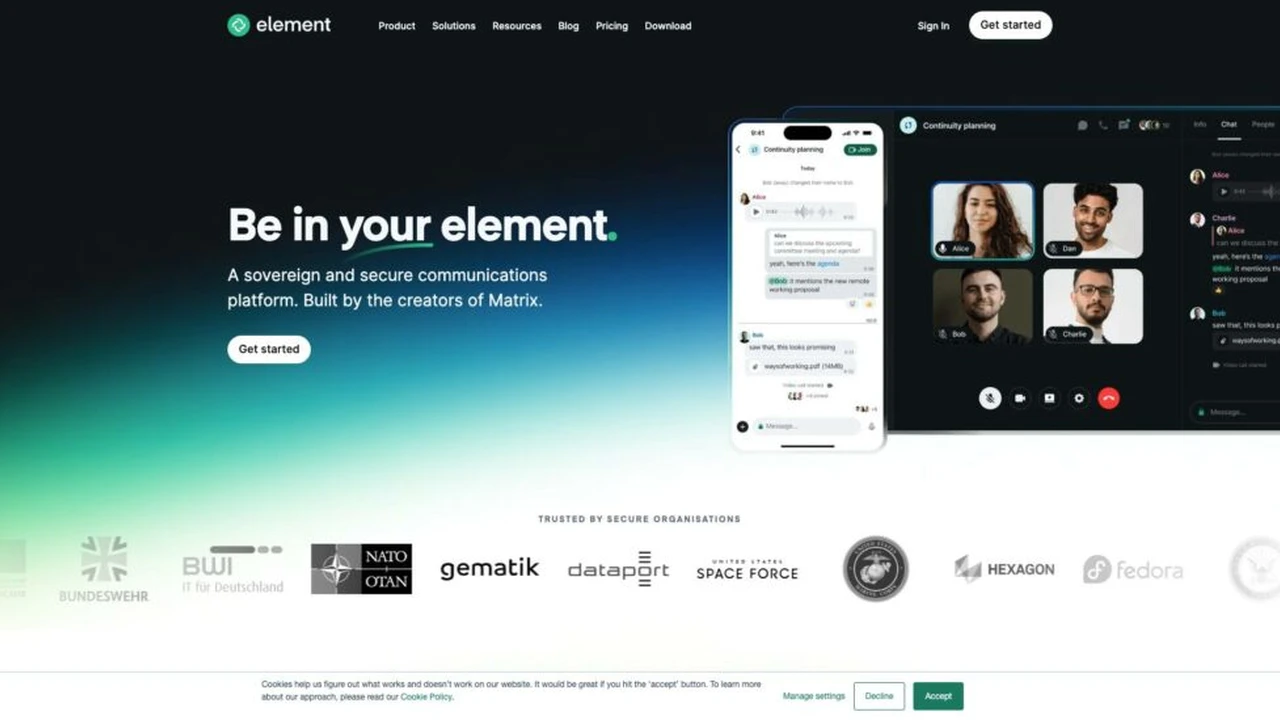
Element Matrix Open Source Decentralized Communication
Overview: Element is a client for the Matrix open network, a decentralized communication protocol. It offers a unique approach to secure messaging by allowing users to host their own servers or choose from various providers.
Key Features:
- Default E2EE: All communications are end-to-end encrypted.
- Decentralized: No single point of control, enhancing resilience and privacy.
- Open Source: Both the Matrix protocol and Element client are open source.
- Interoperability: Can bridge to other messaging networks (e.g., IRC, Slack, Telegram) through integrations.
- Self-Hosting: Users can host their own Matrix server for ultimate control over their data.
- Voice and Video Calls: Supports secure voice and video conferencing.
Pricing: Free to use, with optional paid hosting services.
Ideal Use Cases: Tech-savvy users, developers, and organizations who prioritize decentralization, open-source solutions, and maximum control over their communication infrastructure. Excellent for those in the US and Southeast Asia who want to move away from centralized platforms and potentially self-host their communication.
Pros: Decentralized, open-source, strong E2EE, self-hosting options, interoperability.
Cons: Steeper learning curve for non-technical users, user experience can be less polished than mainstream apps, smaller user base.
Choosing the Right Encrypted Messaging App for Your Needs
The 'best' encrypted messaging app really depends on your individual needs and priorities. Here's a quick guide to help you decide:
- For Maximum Privacy and Security (Journalists, Activists, Highly Sensitive Data): Signal is the undisputed champion. Its robust E2EE, minimal metadata collection, and open-source nature make it the top choice. Threema is a strong contender if you prioritize anonymity and are willing to pay.
- For Widespread Adoption and Ease of Use (General Public): WhatsApp is hard to beat due to its massive user base and default E2EE. However, be mindful of its Meta ownership and metadata policies.
- For Feature-Rich Communication and Large Groups (Community Organizers, Casual Users): Telegram offers a fantastic array of features, but remember to use 'Secret Chats' for E2EE.
- For Anonymity and Avoiding Phone Number Registration: Threema is your go-to.
- For Decentralization and Ultimate Control (Tech Enthusiasts, Organizations): Element (Matrix) provides a powerful, open-source, and decentralized solution.
- For Regional Popularity and Good Call Quality: Viber is a solid choice, especially in areas where it's widely used.
Security Best Practices for Encrypted Messaging Apps
Even the most secure app can be compromised if you don't follow basic security practices. Here are some tips to enhance your digital privacy:
- Enable Two-Factor Authentication (2FA): Always enable 2FA for your messaging app accounts to prevent unauthorized access, even if someone gets your password.
- Use Strong Unique Passwords: Never reuse passwords. Use a strong, unique password or passphrase for your device and any app-specific passwords.
- Keep Your App Updated: Developers constantly release updates to patch security vulnerabilities. Ensure your app is always running the latest version.
- Verify Contacts: If an app offers contact verification (e.g., scanning a QR code), use it to confirm you're talking to the right person and that their encryption key hasn't been tampered with.
- Be Wary of Phishing Attempts: Scammers often try to trick you into revealing your login credentials or installing malicious software. Be suspicious of unsolicited links or requests for personal information.
- Secure Your Device: Your phone or computer is the first line of defense. Use a strong passcode, enable biometric authentication, and keep your operating system updated.
- Avoid Public Wi-Fi for Sensitive Conversations: Public Wi-Fi networks can be insecure. If you must use them, consider using a VPN.
- Review Privacy Settings: Regularly check and adjust the privacy settings within your chosen app to ensure they align with your preferences.
- Be Mindful of What You Share: Even with E2EE, once a message is sent, you lose some control over it. Think twice before sharing highly sensitive information.
The Future of Encrypted Messaging and Digital Privacy
The landscape of digital privacy is constantly evolving. We're seeing ongoing debates about government access to encrypted communications, the development of new privacy-enhancing technologies, and increasing awareness among users about their data rights. As technology advances, so do the methods of surveillance and data exploitation. Therefore, staying informed and choosing tools that prioritize your privacy will remain crucial.
New features like decentralized identity, post-quantum cryptography, and even more robust metadata protection are on the horizon. The goal is to empower users with greater control over their digital lives and ensure that private conversations truly remain private. By understanding the options available and adopting best practices, you can navigate the digital world with greater confidence and security, protecting your communications in the US, Southeast Asia, and beyond.
:max_bytes(150000):strip_icc()/277019-baked-pork-chops-with-cream-of-mushroom-soup-DDMFS-beauty-4x3-BG-7505-5762b731cf30447d9cbbbbbf387beafa.jpg)